
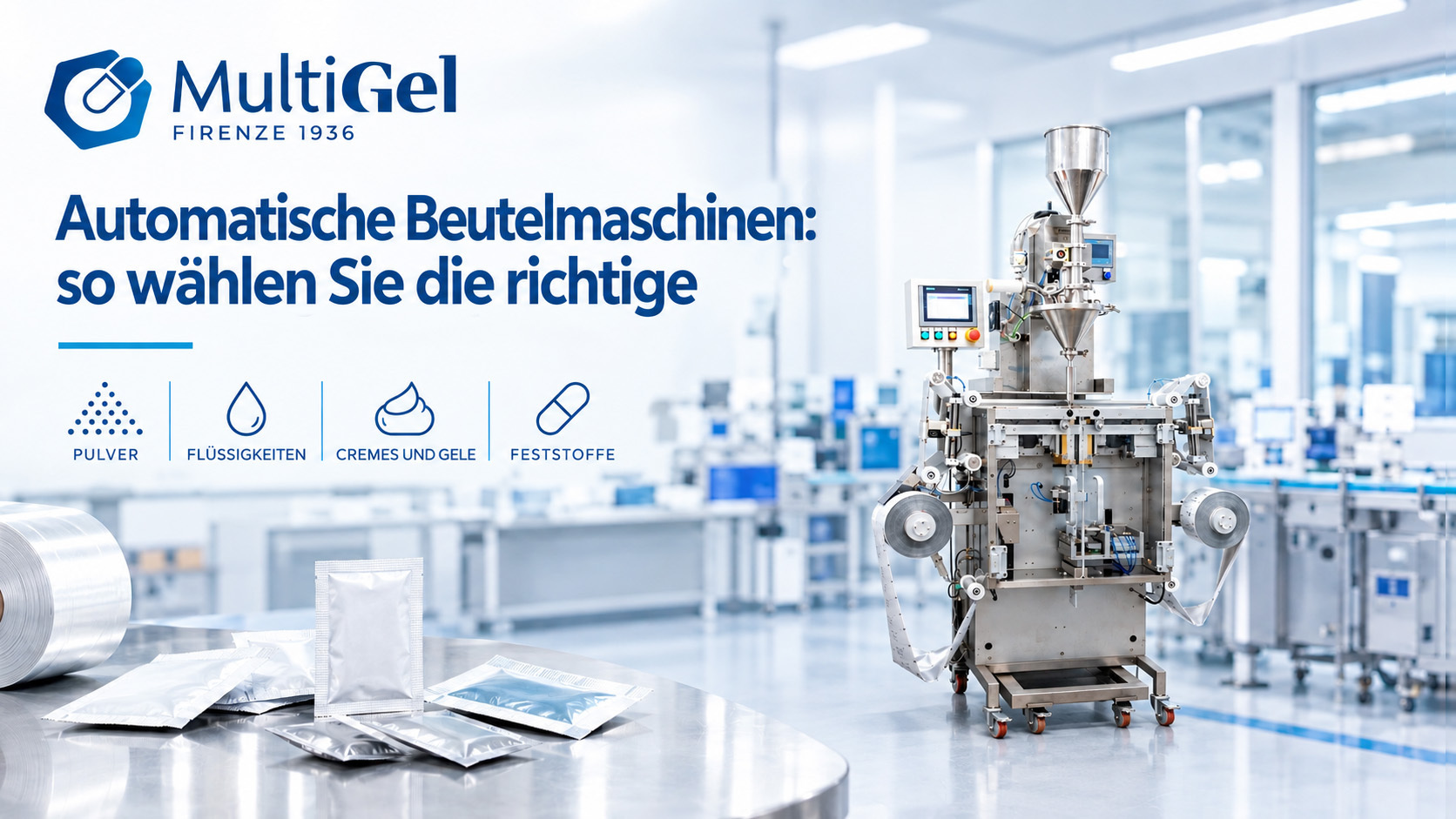
The single-dose format has conquered pharmacies, compounding laboratories, and nutraceutical companies for a very practical reason: a sachet contains exactly the intended amount of the formulation, protects the product until the moment of consumption, and minimizes dosing errors. Behind this apparent simplicity operates a machine that must form, fill, seal, and cut with constant precision, hour after hour. Choosing a single-dose sachet machine suited for your laboratory means comparing formats, dosing systems, materials, and production volumes. Below are the criteria to evaluate before signing an order.
What is an automatic sachet machine
An automatic sachet machine creates the sachet directly from a roll of heat-sealable film, fills it with a predefined dose of product, and seals it. In the most common configurations in the pharmaceutical field, the sachet is sealed on four sides, a solution that guarantees a tight seal and a neat appearance even on small formats.
The working cycle consists of a few well-defined phases:
- Unwinding and folding of the multilayer film;
- Product dosing via the dedicated unit (auger, volumetric, fluid pump, or channel for solid bodies);
- Temperature-controlled side sealing;
- Printing of variable data such as batch number and expiration date;
- Cutting, pre-notching, and discharging of the finished sachet.
In intermittent machines, each phase occurs while the belt is stationary, a condition that favors dosing precision and sealing quality. This is the logic that best adapts to the typical batches of compounding and nutraceuticals, where product variety matters more than sheer speed.
What products can you package in single-dose sachets
A good machine for single-dose sachets is not tied to a single pharmaceutical form. By changing the dosing unit, it can handle very different product families:
- Powders and granules: soluble oral preparations, effervescents, powder supplements. They are the most requested category and the one that demands the most attention regarding flowability and humidity. Learn more about powder sachet machines.
- Liquids and solutions: syrups, oral solutions, oils. A sachet machine for liquids requires dedicated dosing pumps and a sealing management system that accounts for the possible presence of product on the flap.
- Creams and gels: dermatological and cosmetic semi-solid preparations, where viscosity determines the choice of the doser.
- Solid bodies: capsules, tablets, lozenges, softgels, and opaline jars packaged in single doses. You can find the dedicated line among the sachet machines for solids.
This versatility is the first element to evaluate. A laboratory that currently produces only powders might want to launch a liquid single-dose line in two years: a machine designed for quick dosing unit changeovers avoids having to buy a second system.
How to choose a sachet packaging machine: six criteria
Before comparing technical specifications, it is useful to analyze the type of product to be packaged, production volumes, frequency of format changes, and the possible future evolution of the line. A machine sized to the real needs of the laboratory prevents oversized investments and simplifies daily management.
Machines for single-dose sachets in the pharmaceutical sector must also guarantee dosing precision, traceability, and process repeatability, as well as the ability to adapt to different formulations. On this basis, the following six criteria become easier to weigh.

1. Sachet format
Sachet width and length define the working range of the machine. Before evaluating any model, it is best to start from the finished product you want to obtain, not the other way around: a 3-gram powder sachet and a 20-ml solution single-dose have completely different dimensional needs. Always verify that the format range also covers the future developments of your catalog, because the adjustment range cannot be expanded after purchase.
2. The dosing unit
Packaging precision depends on the dosing unit. Powders require auger or volumetric dosers, fluids need peristaltic or piston pumps, and solid bodies require channel or vibrating feeding systems. The maximum dosable volume is a fundamental parameter: it defines the limit beyond which the machine cannot go, regardless of the sachet size.
Always ask how long it takes to replace the unit and if the operation can be performed by internal staff without technical intervention. On small and frequent batches, the format changeover time weighs more heavily on costs than nominal speed.
3. Film material and sealing
Flexible heat-sealable multilayer supports, with an outer layer of paper, plastic, or aluminum, cover almost all pharmaceutical and nutraceutical applications. The choice depends on the product’s sensitivity to light, oxygen, and humidity: aluminum offers a high barrier, while laminated paper can be chosen when certain aesthetic or functional characteristics are sought. The recyclability of the laminate depends on the specific structure of the compound and not just on the outer layer.
An often-overlooked technical parameter is the adjustable sealing temperature. Different materials seal at different temperatures, and a machine with a wide adjustment range gives you freedom in choosing your film supplier.
4. Traceability of variable data
The batch number and expiration date must appear on the individual sachet, not just on the carton. Thermal transfer or inkjet printing systems integrated into the machine solve the problem at the source and eliminate a manual phase that, in addition to taking time, is among the most prone to error.
If you work in a highly regulated environment, also consider the ability to record and recall production parameters from the control panel: it is a concrete indicator of how the machine was designed concerning GMP standards.
5. Real hourly productivity
Technical data sheets report a maximum value that varies depending on the sachet size. Think about your actual needs: a compounding laboratory producing a few thousand sachets a week does not need the same machine as a nutraceutical company with batches of a hundred thousand pieces. Oversizing means tying up capital and taking up space without operational advantages.
6. Cleaning, inspectability, and footprint
Parts in contact with the product must be easily removable and inspectable, made of AISI 316 stainless steel or materials compliant with FDA requirements for product contact. Cleaning between batches depends on this, especially when you change formulations frequently and must document the absence of cross-contamination.
Finally, the available space in the laboratory is a constraint as real as the budget. Compact machines allow the installation of a single-dose line even in environments where a traditional system would not fit.
MP 100 XL: the MultiGel automatic sachet machine
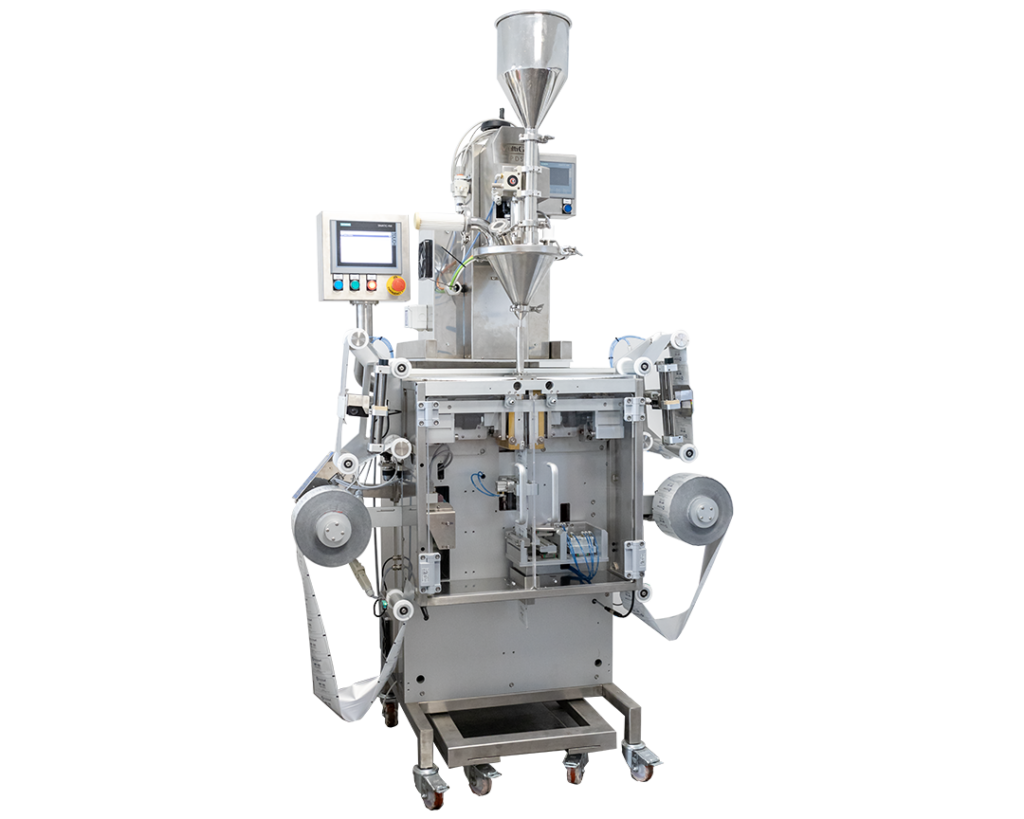
Designed and built entirely in-house, the MP 100 XL is an automatic intermittent machine for creating four-side sealed sachets. Its strength is flexibility: by changing the dosing unit, with volumes up to 60 ml, it switches from packaging powders to liquids, creams, and solid bodies without structural modifications.
The main technical features are:
- Production: up to 2,200 sachets/hour, depending on the sachet size
- Sachet width: from 40 to 120 mm (40, 50, 60, 70, 80, 90, 100, 110, 120 mm)
- Sachet length: from 30 to 160 mm
- Maximum unit dosing: up to 60 ml
- Adjustable temperature: up to 200 °C
- Power supply: 110/230 V single-phase 50/60 Hz
- Energy consumption: 1.5 kW
- Compressed air: 6÷8 bar
- Dimensions: 120x70x170 cm (LxWxH), weight over 200 kg
The thermal transfer printing system prints variable texts such as batch number and expiration date on the sachet, while the touch screen panel makes all production parameters programmable, with the possibility of remote control. The parts in contact with the product are made of AISI 316 steel or material suitable for contact according to FDA regulations, easily inspectable and removable.
With a compact footprint, the machine also works in tight spaces and is used in the nutraceutical, pharmaceutical, cosmetic, herbal, chemical, and food sectors. It is compatible with all flexible heat-sealable multilayer supports, printed or neutral.
From sachet to carton: when a complete line is needed
Packaging the single dose is often only the first step. If the finished product reaches the shelf in a carton, the sachet machine can be integrated downstream with a sachet packaging line that groups, checks, and inserts the sachets into the carton.
Systems of this type include a video camera on the conveyor belt that verifies the correctness of the printed data and automatically rejects non-compliant sachets into a separate drawer. The process is completed by the automatic cartoning machine, such as the ACM 100 model, which manages the insertion of the product and the leaflet, as well as the closure of the carton at speeds up to 6,000 pieces/hour.
Evaluating the entire flow from the beginning, rather than the single machine, prevents ending up with a bottleneck moved further down the line.
Frequently asked questions about single-dose sachet machines
How much does an automatic sachet machine cost?
The price depends on the format handled, the type and number of dosing units, productivity, and required accessories, such as variable data printing or pre-notching. It is always worth considering the total cost over time: energy consumption, spare parts availability, intervention frequency, and support speed often impact the bottom line more than the initial price.
Can a single machine package both powders and liquids?
Yes, if it is designed for changing the dosing unit. This is the case with the MP 100 XL, which switches from powders to liquids, creams, and solid bodies by replacing only the dedicated unit. An adequate cleaning protocol between the two processes remains essential.
Is a compressed air system required?
Most automatic sachet machines require compressed air for movements and pneumatic controls. In the case of the MP 100 XL, the operating pressure is between 6 and 8 bar: a figure to verify on the existing system before installation.
The supplier matters as much as the machine
For almost ninety years, MultiGel has designed and manufactured machines in Barberino Tavarnelle for compounding pharmacies, nutraceuticals, and pharmaceutical packaging, with proprietary technology and spare parts available even for out-of-catalog models. Each sachet machine is configured according to the real needs of the laboratory that will use it, from the sachet format to the dosing system.
If you are considering purchasing a single-dose sachet machine, the quickest way to figure out which configuration is right for you is to talk to the manufacturer.


